The Vikings by Robert Wernick
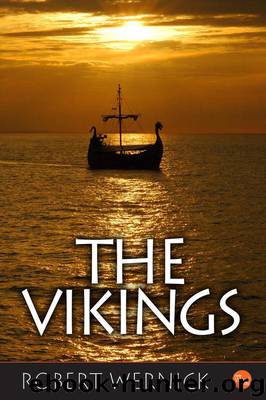
Author:Robert Wernick
Language: eng
Format: epub, azw3, azw
The Vikings were fond of portraying themselves as the ultimate warriors. And quite possibly they were. But there was much more to them than this one-dimensional image. They were, in fact, as much merchants as marauders. Their battle swords went hand in hand with the tiny and delicate scales they used to measure the silver that represented commercial gain. And it was in their mercantile endeavors that they made some of their strongest contributions to civilization.
The Scandinavians were traders long before they became Vikings. The initial source upon which Scandinavian commerce was founded was a marvelous substance that had come as a godsend to the eastern shore of Jutland and the southern Baltic coast. This was amber - the clear, fossilized resin of pine trees that had died millions of years before on land that was, in this case, covered by the waters of the Baltic. The sea washed it ashore in chunks, and it eventually accumulated in such quantities that several thousand pounds of amber could be extracted from an area encompassing only a few acres. Amber was the diamond of its day, fetching premium prices from European ladies, who loved the golden play of light on the strings of amber beads that they wore on their bosoms. It was rendered even more valuable by the fact that when rubbed it took on a highly magnetic charge, a property that seemed magical. In fact, the English word electricity is derived from the Greek elektron, which means amber.
The Vikings traded in amber almost from the start of their history. As early as the second millennium B.C., they were carrying it in crude crafts down the coast of the North Sea and into central and southeastern Europe by way of the Elbe and other rivers. As the Bronze Age faded into the Iron Age, the variety and range of commerce expanded in relation to advances in Norse shipbuilding. The Viking longship and its commercial cousins, the variously sized knarrs, all of them highly maneuverable, enabled the Vikings to probe trade routes never before open to merchant traffic.
Indeed, it required no conflict of identity for the Vikings to lay down their swords and pick up their scales. To realize a profit from their plunder, the Norse raiders sold it in the marketplace. It was said of one of the characters in a saga - a merchant named Thorolf Kveldulfsson - that he divided his time between Viking raids and trading voyages and that the two were often indistinguishable: A Viking merchant bound for the marketplace did not hesitate to turn pirate if he spotted a weaker, commercial-shipping vessel along the way.
This raid-and-trade duality was manifest in many ways and on many occasions. When Viking freebooters established a settlement on the island of Noirmoutier near the estuary of the River Loire in 842, they had more in mind than a base for raids in France. Noirmoutier was situated in an area of lush vineyards and marshes whose waters, when drained and channeled into separate, shallow basins, could be allowed to evaporate leaving layers of salt.
Download
The Vikings by Robert Wernick.azw3
The Vikings by Robert Wernick.azw
This site does not store any files on its server. We only index and link to content provided by other sites. Please contact the content providers to delete copyright contents if any and email us, we'll remove relevant links or contents immediately.
| Africa | Americas |
| Arctic & Antarctica | Asia |
| Australia & Oceania | Europe |
| Middle East | Russia |
| United States | World |
| Ancient Civilizations | Military |
| Historical Study & Educational Resources |
Cecilia; Or, Memoirs of an Heiress — Volume 1 by Fanny Burney(32569)
Cecilia; Or, Memoirs of an Heiress — Volume 2 by Fanny Burney(31968)
Cecilia; Or, Memoirs of an Heiress — Volume 3 by Fanny Burney(31948)
The Secret History by Donna Tartt(19128)
Sapiens: A Brief History of Humankind by Yuval Noah Harari(14400)
Leonardo da Vinci by Walter Isaacson(13351)
The Radium Girls by Kate Moore(12042)
Sapiens by Yuval Noah Harari(5377)
How Democracies Die by Steven Levitsky & Daniel Ziblatt(5227)
The Wind in My Hair by Masih Alinejad(5108)
Homo Deus: A Brief History of Tomorrow by Yuval Noah Harari(4929)
Endurance: Shackleton's Incredible Voyage by Alfred Lansing(4792)
Man's Search for Meaning by Viktor Frankl(4621)
The Silk Roads by Peter Frankopan(4541)
Millionaire: The Philanderer, Gambler, and Duelist Who Invented Modern Finance by Janet Gleeson(4489)
The Rape of Nanking by Iris Chang(4228)
Joan of Arc by Mary Gordon(4122)
The Motorcycle Diaries by Ernesto Che Guevara(4110)
Stalin by Stephen Kotkin(3975)
